Thursday, April 24, 2008

Hubei University

My "home" for at least two weeks of my trip will be an apartment on the campus of Hubei University. The following images are what the university displays to students interested in applying to the University. So I'm guessing my accommodations will be similar. Looks very nice.
We will have INTERNET access while there, so I should have no problem keeping the blog going. Now, if I can just get over the FOOD thing.....haha.

Not sure I'll have much use for the Television....since I don't speak enough Chinese for it to make any difference. ha ha.

Panda Cubs


How can you NOT look at these guys and smile? Amazing

Sunday, April 20, 2008

Marco Polo

As a person from the West, that is about to go and spend a month in the Far East...I can't help but feel a connection to one of best known of the earlier visitors from the West, Marco Polo. I have to admit I have always had a strong interest in Marco Polo and his journey. I guess my love of travel has pulled me to his adventure, and his story . I also find it very interesting that so many people still question that he actually made the trip all the way to China...but as much as I have read and studied about Marco Polo, it is very obvious he made the journey and fell in love with Cathay (the Medieval name for China) and the people there, not the least of which was their impressive leader...Kublai Khan. Marco most certainly was amazed and impressed with this most powerful ruler of 1271.

Having said all that, it is amazing how little information there is in "ONE PLACE" that deals with this story. (other than from Polo's own book of course...which is good reading as well) That is until recently. MARCO POLO: From Venice to Xanadu by Laurence Bergreen is my newest read in my preparation for visiting China. It does an excellent job of not only using Marco's writings, but also researching other sources from the time, and visiting the places that Marco visited. I am about 1/2 through this and it is EXCELLENT!


Another source, is from National Geographic. Mike Edwards and his photographer companion, Michael Yamashita traveled in the footsteps of Marco Polo and recorded what the current world is like along Marco's trail. They traveled 6,000 miles through 8 countries.

The slideshow is very nice.


The return home site can be found here.

There is also an online exhibit put together by the Metropolitan Museum of Art in New York, that is interactive and has some good information.


In the Footseps of Marco Polo

Thursday, April 17, 2008

Soaring World Food Prices

The growing crisis of higher food prices (particularly of grains) throughout various parts of the world, is something that should be watched. The growing demand for cheaper fuels..(ethenol for example) had caused the price of grains such as corn to triple in the past couple of years or so. It takes the same amount of corn to feed one person for a year, that is required to fill one 25 gallon tank of an SUV. Where are the priorities...particularly in this nation. China certainly has reasons for concern as more and more of their 1.3 billion people begin driving cars, while others...many others are on the verge of starvation.


CLICK HERE

Monday, April 7, 2008

Before The Deluge


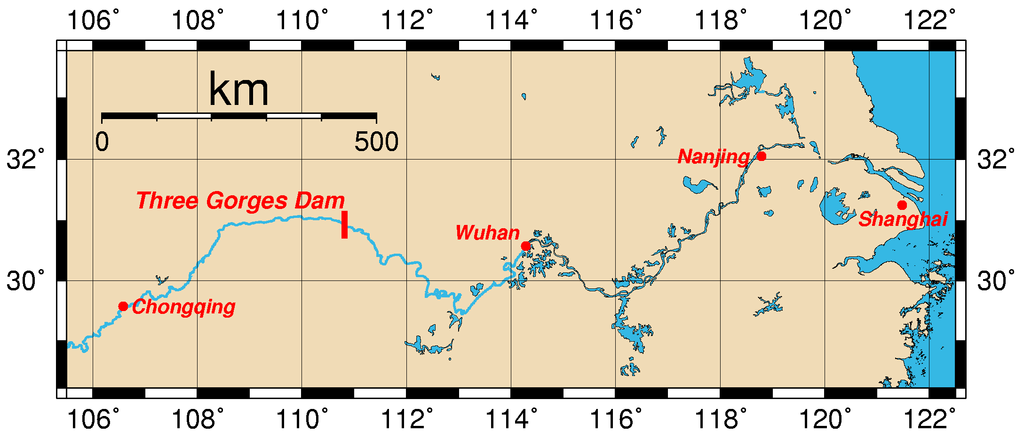
The next book I am reading in my preparation for visiting China, is The Deluge: The Vanishing World of the Yangtze's Three Gorges by Deirdre Chetham. It deals with the impact of the Three Gorges Dam on the Yangtze River. (The three gorges are Qutang Gorge, Wu Gorge, and the Xiling Gorge)

Numerous towns and villages along the Yantzge will be flooded, displacing estimates of 1.5 to 3 million people when the Three Gorges Dam is completed (in 2011). Whole cities and villages have been rebuilt hundreds of feet above their original locations, sometimes on opposite sides of the river. This probably brings into play more millions (and billions) of dollars that will be required for this mass exodus of the millions of displaced people. This massive undertaking has already been compared to such Chinese creations as the Grand Canal, and the Great Wall. It is easy to understand the comparison as one looks out over the massive complex that makes the dam. When completed it will be the largest hydro-electric power station in the world, creating a total electric generating capacity of 22,500 megawatts. The dam itself was created using a model of the TVA system here in the United States. It was created as a means of flood control and drought relief as well as a means of producing hydro-electric power for the millions.

What will be the world's largest hydroelectric dam is under construction in the remote Three Gorges area of China's Upper Yangtze River. Of the nearly 1500 towns that will be submerged when the project is complete, the author focuses on a handful that she knows well from her experiences as a river guide and lecturer. She describes their residents involved in their daily affairs-working, worshiping, getting by-even as the flood waters ineluctably rise around them. In some cases, communities that have existed for thousands of years, whose entire histories and cultures are centered on the river, that have survived flood, famine, and war, will be forced to uproot themselves forever. Against this backdrop, the author also recounts the broader controversies and political deal-making that went into the decision to build the dam. This book had to be written now because in just a few years these people and their world will be gone. -From Library Journal


There is also an excellent NPR series on the Three Gorges Dam and the impact on the people and landscape in this area of China.

Monday, March 31, 2008

Chinese Lessons

The second book in my study of China prior to the trip is CHINESE LESSONS by John Pomfret.

From the jacket cover....

CHINESE LESSONS: Five Classmates, and the Story of the New China is Washington Post reporter John Pomfret’s evocative recounting of the lives of his former classmates in the Nanjing University History Class of 1982. As one of the first American students to live and study with Chinese after the revolution, Pomfret saw the country as few Americans had. Leaving China in 1982, Pomfret returned for the Tiananmen Square protests and the crackdown of June 4, 1989. Expelled by the Chinese government at that point, he again returned to live from 1998-2005 as the Post's bureau chief in Beijing.

Pomfret uses the lives of his classmates as a vehicle for telling China's story, one of the most tumultuous the modern world has ever known. His classmates came from villages and cities; some were Red Guards; others were beaten by Red Guards; some siblings starved to death during the calamitous Great Leap Foward...

This book is almost too much to take at times. The unbelievable cruelty that was put upon some of these people causes me to stop and actually catch my breath. It truly is amazing what people, "everyday" people can endure.

Whereas Oracle Bones was something that dealt with the recent modern history of China (1990s-2000s), this book...although it does jump forward to the present, spends most of the time in the 1950s, 60s, and 70s, opening up the Cultural Revolution of Moa and the incredible cruelty and many times stupidity of his reign, from an "insider's" view.

Worth the read!

You can also catch John Pomfret here on

Sunday, March 30, 2008

Qing, Dragons, Red Lacquer

Yesterday was our group's second meeting in Memphis. We met at the Belz Museum of Asian and Judaic Art. This isn't a very large museum, but it does have a wonderful collection of Chinese artifacts. There are many amazing pieces of jade and ivory carvings. Check out the mystery balls if you go, or the jade chains that are long chains made of jade that are cut from ONE piece of jade.
It really is amazing.

We learned some interesting facts about the imperial world of the Qing dynasties and about Chinese imperial dragons. I'll mention three things here that stood out.

First: The Qing dynasty is also known as the Manchurian Dynasty. It was the last ruling dynasty of China prior to the founding of The People's Republic of China. The Manchurian were horsemen that were not ethnic Han Chinese, so there are some differences in their rule.
One of these can be seen in the design of the imperial robes. If you look at the robes prior to the Qing (pronounced Ching) dynasty, they don't have cuffs on the robes. They are either flared out and large or they are just straight sleeves, like the image below.

The Qing/Manchurians were horsemen from the plains, and greatly loved and depended on the horse. It is thought that the cuffs on their robes, such as the previous image to the top left, were formed to look like the horse's hoof.

Also notice that both of these robes are yellow. That is the imperial color. You will also notice they have the imperial dragon on them(click the images for a more detailed view of the dragon). The imperial dragon is different from the other dragons, because he has 5 claws. Other Chinese nobles would have dragons with 2 or 3 or 4 claws, but only the emperor would have the five clawed dragon.

Below is the Qing Imperial Dragon. Notice the yellow background and the five claws.
Another interesting thing about the Chinese Imperial Dragon, is that he is made up of nine different parts. He is made from nine different animals. Can you find the nine different animals represented in the dragon?

Another interesting artifact is the red lacquer they use to create objects, anything from a chair to a writing set seen here. They take wood and build the base of the object from the wood. Then the red lacquer is applied many many times until it is thick enough to start carving into the shapes wanted in and on the object(again click on the images for more detail). It is really amazing when you think about the TIME involved in all of these artistic processes. Something that in today's world of instant everything seems virtually impossible, or something that would take at least one lifetime to create.

Friday, March 28, 2008

Chinese Zodiac & Chinese New Year

The Chinese animal signs are a 12-year cycle used for dating the years. They represent a cyclical concept of time, rather than the Western linear concept of time. The Chinese Lunar Calendar is based on the cycles of the moon, and is constructed in a different fashion than the Western solar calendar. In the Chinese calendar, the beginning of the year falls somewhere between late January and early February. The Chinese have adopted the Western calendar since 1911, but the lunar calendar is still used for festive occasions such as the Chinese New Year. Many Chinese calendars will print both the solar dates and the Chinese lunar dates. (from the site http://www.c-c-c.org/chineseculture/zodiac/zodiac.html)


Chinese New Year


Tuesday, March 25, 2008

Breakfast In China

One of the main things that people mention when I tell them that I will be in China, is the food. There are those who have an adventurous spirit about trying new things in regard to food...there are the others that are a bit reserved about the cultural "divide" when it comes to the differences in diet.

I must admit if I have any reservations about China, there are two that stand out. One would be about pollution and the other about food. So I have been doing a bit of research on both. I believe that mentally preparing yourself for anything that might be a challenge is 95% of tackling the "problem." So research and knowledge ahead of time helps with this mental preparation.

The following link is one of those sites that is helping in this mental prep.

BREAKFAST in CHINA (and other meals)

Luckily I already have down the art of actually EATING (with chopsticks)...but for those who don't this video might be of some help.

How To Use Chopsticks


And for the cooks out there...
How To Cook Chinese

Monday, March 24, 2008

Peter Hessler


In his new book, Oracle Bones: A Journey between China's Past and Present, Hessler, who has lived in China for the past nine years and is the Beijing correspondent for The New Yorker, looks at the country through a kaleidoscopic lens of history, archeology, language, and contemporary culture.The title Oracle Bones refers to the earliest known writing in East Asia, inscriptions from the Shang dynasty more than three thousand years ago. As Hessler follows contemporary events, he returns again and again to these fragile first records of history in China, exploring the tension between a nation's troubled past and its determination to look to the future. His narrative follows individuals who make their way through a changing China. By following these stories, and interweaving them with portraits of archeology and history, Hessler gives the reader a new perspective on the dramatic transformation of today's China.... (from WGBH public television in Boston)

FOR VIDEO: CLICK HERE

This is a link to a speech Hessler gave in Boston on
Tuesday, May 16, 2006 at
The Boston Athenaeum
You may also read TIME's Asian Journey that Hessler wrote about his journey back to Fuling, the setting of his first book RIVER TOWN.